revised authorial version · 2026
The Soup Bowl Between Function, Symbol, and Play
Note on the revised edition
This text is a structurally, stylistically, and grammatically revised authorial version of the paper published in 2019. Its central idea, context, Homo faber / Homo ludens opposition, and the project Paradox have been preserved. Terminology has been clarified, the references have been standardised and supplemented with sources on Homo ludens and kintsugi, and the punctuation has been corrected. The English text is an academic translation of the revised Bulgarian version. Comparative images from the original publication remain available in the original PDF; only the author’s own photographs are reproduced here.
Abstract
The paper examines vessel form-giving through the interrelations between function, meaning, symbol, and sign. The soup bowl is treated as an archetypal form through which two complementary lines of interpretation are traced: the vessel as an extension of practical gesture (Homo faber) and the vessel as a field of play, metaphor, and personalisation (Homo ludens). The analysis draws on the analogy between the hand, the line, and the concave surface, as well as on the oppositions preservation / presentation, closing / opening, and inside / outside. The author’s project Paradox is presented as a conclusion: it combines concave and convex surfaces and permits both functional and playful uses of form.
Keywords: cultural tradition, form-giving, vessels, symbol, sign, Homo faber, Homo ludens, design
1. Point of Departure
Cultural tradition directs attention towards particular phenomena, while others, although essential, remain in the background. In everyday life, we use numerous objects without always recognising their significance or the ways in which we interact with them. Vessels belong to this category of seemingly ordinary objects.
The Bulgarian word sad (vessel) itself introduces layered imagery: a court of law, a watercraft, and a container used for storage or food. The relationship between the word, its meanings, and its form generates analogies. A vessel has a shell that separates inside from outside and protects what it contains. Symbolically, the bowl may be related to the human body as a container of essence. This enclosing surface therefore becomes a subject of design analysis.
The aim is not to construct an exhaustive history of vessels, but to use comparative and interpretative reading to trace how function, gesture, metaphor, and play participate in the form-giving of the soup bowl. Analogy and metaphor operate as heuristic tools for discovering new relationships within one of the simplest domestic forms [1, 4].
2. The Vessel as Symbol and Sign
As a sign, the vessel has testified to human presence since remote antiquity. When we cup our hands, we instinctively create a space capable of retaining contents. The resulting surface is inward-curving, or concave. Within this gesture, the hand may be understood as a line and the movement of the hands as a transformation of meaning and function.
Hands held close together suggest preservation and containment. As they open, the vertical lines move apart, a hollow appears, and the gesture shifts towards offering and presentation. Form-giving can thus be read as a movement from vertical to horizontal, from closing to opening, and from interior to shared space.
Metaphorically, the concave surface constitutes space, the contents introduce time, and movement connects both categories to form. Space, time, and movement allow the concrete object to be considered through abstract relations. Gesture does not merely employ the vessel; it precedes and explains its form.
Two Directions of Gesture
preservation
vertical · closing · interior space · function
presentation
horizontal · opening · shared space · relation
3. Form and Function: Homo faber
A bowl is commonly defined as a vessel for food, often shaped as part of a sphere and varying in depth according to use. Behind this apparent simplicity lies a stable relationship between necessity, material, and operation. Historically and geographically diverse examples display a comparable structural logic: the inner space must collect, preserve, present, and distribute.
From the perspective of Homo faber—the human as maker—function takes precedence. The space inside the vessel determines its boundaries, while the movement of the hands reveals their logic. The analogy is particularly visible when clay is formed on the potter’s wheel: the hands do not merely generate motion; they form space. Form emerges between the fingers.
Material—its structure, colour, and technological properties—provides the basis upon which imagination develops [3]. Decoration may supplement the object but need not disturb its purpose. When functional logic dominates, attention turns towards the action, and the vessel is perceived as an extension of gesture. It is present through its construction yet recedes behind its use.
4. Form and Play: Homo ludens
A second aspect is form as play. The concept of Homo ludens identifies play as an essential element of culture rather than the opposite of serious action [6]. In design, play supplements function and opens a space for personalisation, emotion, and creative experiment. Analogy and metaphor can alter the way in which a familiar object is recognised and used.
In sculptural interpretations, the bowl often acquires human features—feet, fingers, or other bodily associations. Such transformations activate the paradox of static and dynamic form and incorporate the gestures of bringing and carrying away into the image of the object. The vessel no longer performs a function alone; it provokes a relationship.
Another example is the Japanese practice of kintsugi, in which broken ceramics are repaired with lacquer dusted with gold [7]. In contemporary interpretations, the trace of breakage is not concealed but becomes a visible part of the object’s history and value. Here metaphor does not cancel function; it unfolds another semantic layer, allowing the vessel to become an image of memory, vulnerability, and continuation.
5. The Authorial Project Paradox
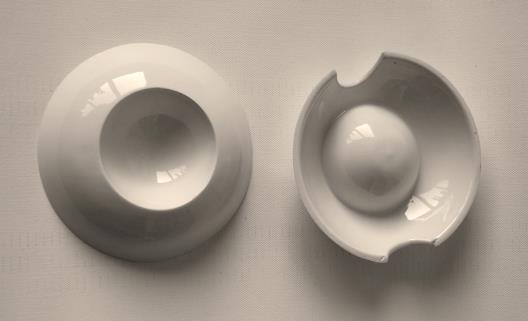
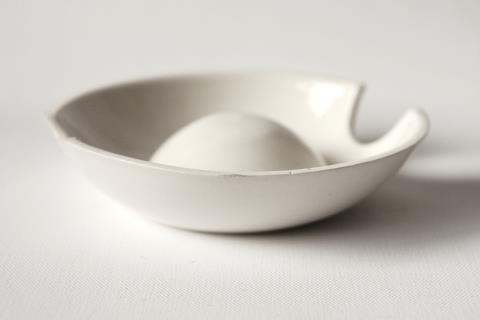
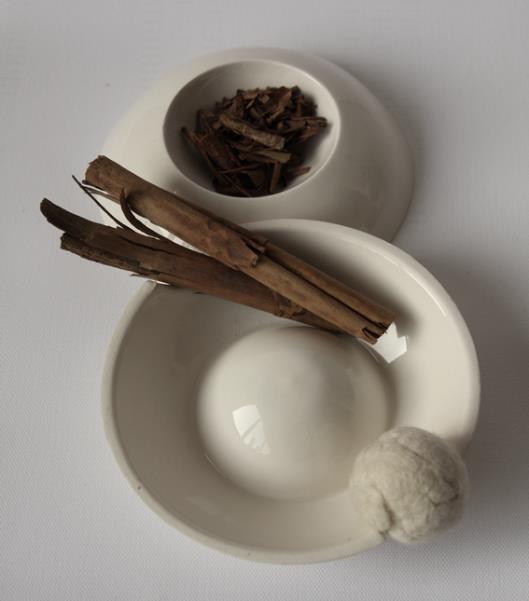
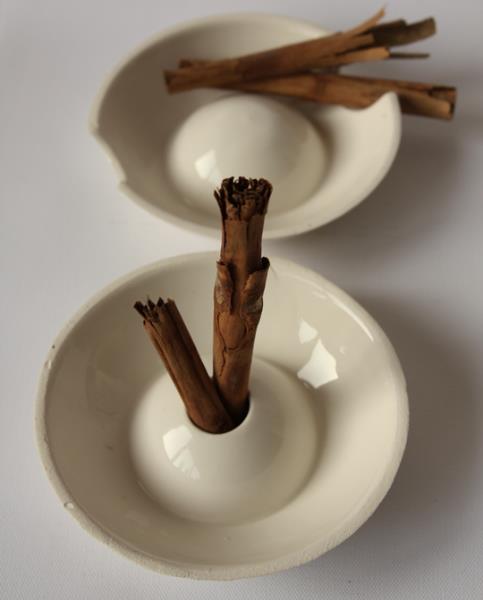
The authorial project Paradox combines two opposing surfaces—concave and convex—so that two spaces can be used within a single object. The form seeks to unite functional and playful principles, leaving the user free to alter the arrangement, contents, and mode of use.
The point at which the two surfaces meet is both a connection and a reversal. The line that defines the maker’s space from within becomes, on the outside, the line of the player. It is the same boundary perceived from two sides. In this sense, the point can simultaneously be understood as beginning and end, inside and outside.
Through transformation, the point expands into a sphere whose inner and outer sides acquire functional potential. Vertical and horizontal are no longer fixed directions but depend on reversal and use. The object extends its practical possibilities while becoming an invitation to artistic intervention by the person who uses it.
6. Conclusion
Considering the vessel through function, gesture, symbol, and play demonstrates that even the apparently simple bowl contains layered relationships. Homo faber and Homo ludens are not mutually exclusive models. They name two complementary directions: one organises material according to necessity, while the other transforms necessity through imagination.
The analysis of preservation and presentation, closing and opening, inside and outside creates new perspectives for design development. Analogy and metaphor do not replace structural logic; they expand the field within which form can be understood, experienced, and used.
connection with artistic practice
Dialogue and Game
The series Dialogue and Game materialise the same tension between the stable ceramic form and its transformation through movement, relationships, and play. The porcelain elements preserve the vessel’s archetype, while their changing assembly and the addition of soft or textile lines alter its interpretation.
view the Dialogue and Game series →References
- Popov, P. Kompozitsiyata kato abstraktsiya [Composition as Abstraction]. Sofia: Arch Libri, 2007. [in Bulgarian]
- Zheleva-Martins, D. “Teoriyata na kompozitsiyata kato teoriya na znatsite” [Composition Theory as a Theory of Signs]. Paper presented at Achievements and Trends in the Development of Contemporary Design and Decorative and Applied Arts, National Academy of Art, Sofia, 18 November 2010. [in Bulgarian]
- Chervendinev, G. “Dizaynat kato sredstvo za zapazvane na traditsiite v usloviyata na savremennoto konsumatorsko obshtestvo” [Design as a Means of Preserving Traditions in Contemporary Consumer Society]. Modern Technologies in Cultural and Historical Heritage, vol. V, TU–Sofia, 2017, pp. 132–137. ISSN 2367-6523. [in Bulgarian]
- Georgieva, B. “Geometric Heuristics in Art and Design.” Proceedings of the University of Ruse, vol. 56, book 1.1, 2017, pp. 125–129. ISSN 1311-3321. ↗
- Georgieva-Gushtanova, B. “Origami Based Technology for Handbag Production.” 15th International Conference Standardization, Prototypes and Quality: A Means of Balkan Countries’ Collaboration, Trakya University, Edirne, 2019, pp. 273–279. ISBN 978-975-374-247-4. ↗
- Huizinga, J. Homo Ludens: A Study of the Play-Element in Culture. London: Routledge, 1949; reprint edition, 2014. ↗
- Victoria and Albert Museum. “V&A Youth Collective / Objects and Opinion—Sustainable Histories.” 2021. Note on the practice of kintsugi. ↗